June 15, 2026
George Walker: June Composer of the Month

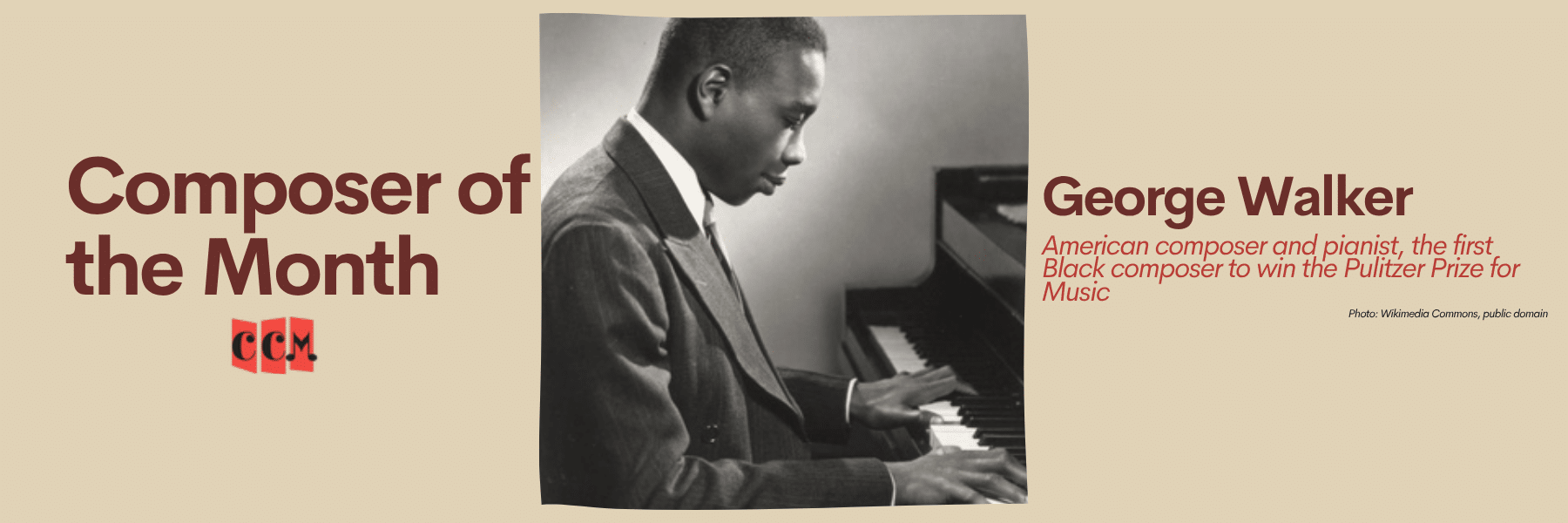
Our June Composer of the Month was born on June 27, 1922: George Walker — pianist, teacher, and the first Black composer ever awarded the Pulitzer Prize for Music.
If you’ve never heard his Lyric for Strings, stop reading and put it on. Ten minutes of slowly unfolding string lines, written when he was twenty-four, in memory of his grandmother. Audiences who love Barber’s Adagio for Strings tend to fall hard for it, and then wonder why nobody played it for them sooner. That question, in many ways, is the story of George Walker’s life.
Early Life and Inspirations
George Walker grew up in Washington, D.C., the son of a physician who had emigrated from Jamaica and a mother, Rosa, who sat beside him at the piano from his very first lesson at age five. Rosa had strong opinions about wasted practice time. Decades later, Walker still credited her ear and her insistence for everything that followed.
What followed came fast. He left for the Oberlin Conservatory at fourteen. From there he earned a place at the Curtis Institute of Music, one of the most selective schools on earth, where his piano teacher was the great Rudolf Serkin. In 1945 he graduated with diplomas in both piano and composition, becoming the first Black graduate in the school’s history.
The piece that outlived everything else from those years wasn’t written for a stage. While Walker was at Curtis, his grandmother died, a woman who had been born into slavery and lived to see her grandson at a world-famous conservatory. He poured his grief into a slow movement for string quartet. Renamed Lyric for Strings, it became the most performed music he ever wrote.
A Career of Firsts and Closed Doors
In November 1945, Walker gave his debut recital at New York’s Town Hall; the New York Times called it “notable.” Two weeks later he stood in front of the Philadelphia Orchestra and played Rachmaninoff’s Third Piano Concerto, one of the most difficult pieces in the repertoire, with Eugene Ormandy conducting. He was the first Black instrumentalist ever to appear with that orchestra, in the first year anyone had let him try.
By every musical measure, a major concert career should have followed. It didn’t. Concert managers in 1940s America would not represent a Black classical pianist, however brilliant. The doors that had opened at Curtis and Town Hall quietly closed.
Walker’s answer was to out-build the obstacle. He earned a doctorate. He won a Fulbright to Paris and spent two years with Nadia Boulanger, the most famous composition teacher of the century, who was reportedly so impressed that she waived her usual requirements for him. (Longtime readers may remember Boulanger as our July 2024 Composer of the Month. Walker was among the many great Americans she shaped.) And he taught for decades, most of them at Rutgers University, while writing more than ninety works that America’s greatest orchestras slowly, steadily began to commission.
The Pulitzer, Fifty Years Later
In 1996, the Boston Symphony premiered Lilacs, Walker’s setting of Walt Whitman’s elegy for Abraham Lincoln, for soprano and orchestra. The Pulitzer jury’s vote was unanimous. George Walker was seventy-three years old, more than half a century past that historic Curtis graduation, when he became the first Black composer to win the Pulitzer Prize for Music.
He treated the prize as a checkpoint, not a finish line. Walker kept composing into his mid-nineties and passed away in 2018 at ninety-six. Music stayed in the family: one son is a violinist and composer, the other a playwright.
What Students Can Learn from George Walker
Walker’s story carries a lesson we watch play out in our studios every week: mastery is built at the instrument, hour by hour, long before the world takes notice. Doors were closed to him that swung open freely for others. His response was to become undeniable — as a pianist, as a teacher, and finally as a composer whose music outlasted every barrier put in front of it.
Start Listening
New to Walker? Start here:
- Lyric for Strings — his most beloved work; ten minutes, and you’ll understand why.
- Lilacs — the Pulitzer winner. Whitman’s poetry and radiant soprano writing.
- Piano Sonata No. 1 — Walker the virtuoso pianist speaks.
- Address for Orchestra — the sound of American orchestras rediscovering him.
Whether your child is beginning piano lessons or preparing for an audition, George Walker’s music, and his example, belong in their ears.
Sign up for a FREE introductory lesson at The California Conservatory of Music today!