
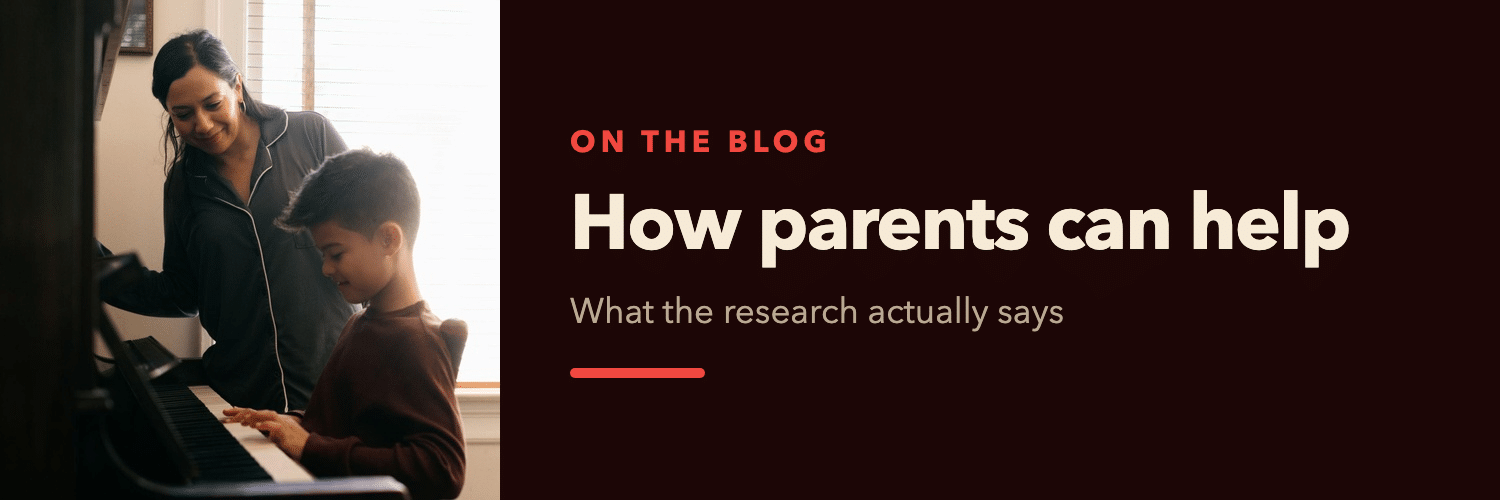
Most of the parents who bring a child for their lesson at CCM have never played an instrument themselves, and many of them worry that this leaves them on the sidelines. The good news is, it doesn’t! The things that make the biggest difference at home are things you can do without reading a note of music.
Here is what they are, and how we know.
What separates the families who thrive
The most useful study on this compared 337 families, all of them learning violin one-to-one. The researcher surveyed the child, the parent and the teacher, then looked at each household as a unit instead of studying the children on their own.
Two of the groups she identified were made up of parents who were equally involved. The same hours, the same effort, near-identical scores on every measure of support the study took. The children in one of those groups were the happiest and most confident in the whole sample. The children in the other were the least.
The difference was not how much. It was how. In the group that struggled, the teacher gave instructions and the parent made sure they were carried out at home, which left the child as the only person in the arrangement without a say. In the group that thrived, all three talked to each other and the child had some say in how practice went.
One more finding is worth knowing before you draw the obvious conclusion. The families where almost nobody talked to anybody, where the parent stayed out of it entirely, did the worst of all. So this is not an argument for stepping back. It is an argument for a different kind of involvement, and every part of it is available to a parent who has never held an instrument.
Ask your child what they want from you
Some children want a parent in the room while they practice. Others find it unbearable. Both are completely normal, the answer changes as they get older, and most parents never think to ask.
It takes one conversation, and it saves a surprising number of arguments.
Keep them in the conversation about practice
Your teacher sets what needs doing and how often. Inside those boundaries, there is usually room for your child to have a say in when and how, and children who get that say tend to push back less.
“When are you going to fit it in today?” gets further than “go and practice now.” It is the same expectation. It just arrives as a question.
Give practice somewhere to happen
A guitar in a case under a bed gets played less than a guitar on a stand in the corner. A keyboard that has to be set up is a keyboard that gets set up less often.
This sounds too small to matter. It is one of the biggest differences between the households we see, and it costs nothing but a decision about where things live.
Protect the relationship with the teacher
A lot of the work is being done by whether your child likes and trusts their teacher. You can help that along simply by taking an interest in it, and by talking to the teacher yourself.
Two minutes at pickup tells you more than any practice chart, and it tells your teacher things about your child that never surface in a lesson. If something is not working, we would always rather hear it early.
Be the audience
This is the one most often skipped, and the one the research keeps pointing at. The phrase in the study is that the parents whose children did best remained “a supremely interested audience.”
It means asking to hear the piece. Sitting down while they play it. Saying what you noticed rather than whether it was good, because “that bit in the middle sounds completely different from last week” proves you were listening in a way that “well done” never will.
You do not need to know whether they played it correctly. You only need to know it is not the same as it was in September, and any parent can hear that.
What fifteen years has shown us
Research describes averages. It cannot tell you what a Tuesday evening looks like in your house. This part is ours.
The families who last are almost never the ones with the strictest practice regime. They are the ones who treat lessons as an ordinary part of the week, the way swimming or soccer is, and who keep turning up when the week has gone badly.
One of our own parents put it better than we would have. Asked what advice she would give someone just starting, Rohan’s mother told us their mantra is simply to keep showing up to class, week after week. Progress in music is not made of perfect weeks. It is made of a long run of ordinary ones.
Try this tonight
Ask your child to play you the piece they are working on. Not the finished one they can already play well. The one still in progress, the one that is a bit of a mess.
Then ask one question about it. Which part is hardest? What are you meant to be fixing? What does your teacher keep saying?
Most children talk for longer than you expect, because it is rare for an adult to ask.
Where this comes from
Claims about research should be checkable, so here is what the above rests on.
Creech, “Learning a musical instrument: the case for parental support,” Music Education Research, 2010. The study of 337 parent-pupil-teacher trios, and the source of the phrase “a supremely interested audience.”
Creech and Hallam, “Learning a musical instrument: the influence of interpersonal interaction on outcomes for school-aged pupils,” Psychology of Music, 2011. The same families, and the paper that sets out the limits: a 42 percent response rate, teachers choosing who received the survey, and no students who had already stopped lessons.
Both studies followed violin students in Britain, and both are surveys taken at a single moment, which means they show what travels together rather than what causes what. Whether the same pattern holds for piano, guitar or voice has not been tested at anything like the same scale. We treat it as a strong hint rather than a proven rule, and it matches what we see.
Book a free trial lesson at The California Conservatory of Music today!
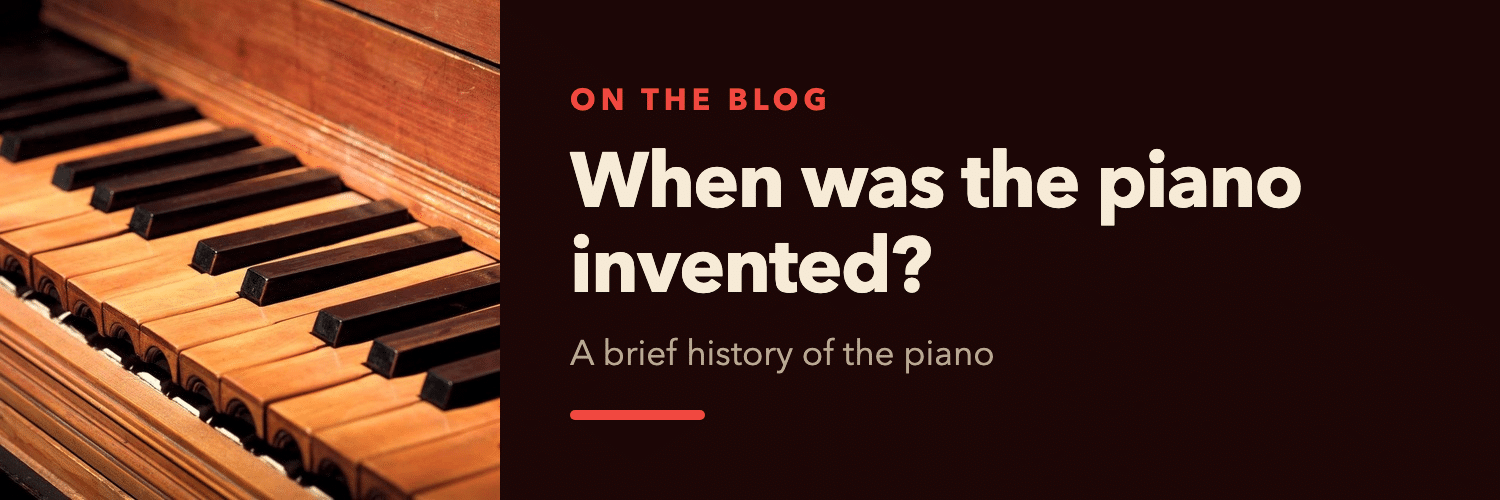
The piano is younger than most people assume. The violin had already been around for about a hundred and fifty years before the first one was built, and unlike the violin, we know exactly who built it.
Who Invented the Piano?
The piano was invented by Bartolomeo Cristofori, an Italian instrument maker born in Padua in 1655.
In 1688 he was hired by Grand Prince Ferdinando de’ Medici to look after the Medici family’s harpsichords in Florence. That was the job: tuning, repairing, maintaining and moving a large collection of keyboard instruments. He was not a composer and he was not famous. He was the man who kept the instruments working, and he had a workshop and the time to think.
This is worth pausing on, because the violin has no equivalent. Ask who invented the violin and the honest answer is that nobody did, exactly. It emerged gradually in northern Italy across the early sixteenth century through the work of many makers. The piano is the opposite. One man, one workshop, one invention.
When and Where Was the Piano Invented?
In Florence, around 1700.
The firm evidence is an inventory of the Medici family’s musical instruments drawn up in 1700, which lists something new: “an arpicembalo by Bartolomeo Cristofori, of new invention, that makes the soft and the loud.” A court musician named Federigo Meccoli separately recorded the same year for the same instrument, which gives us two independent contemporary witnesses.
So the piano is about 325 years old.
Why you will see 1709 quoted everywhere
Search for this question and a great many sources, including some very reputable ones, will tell you 1709. That date comes from a different event. In 1709 the writer Scipione Maffei interviewed Cristofori and saw the instrument, and he published a description of it, complete with a diagram of the mechanism, in 1711.
1709 is when the piano was written about. 1700 is when the records show it already existed. You will also occasionally see 1698, which rests on a single diary whose authenticity scholars now doubt.
Why Is It Called a Piano?
Maffei called it a gravicembalo col piano e forte, which means “harpsichord with soft and loud.”
People got tired of saying that, so it was shortened to pianoforte, and then shortened again to piano. The instrument is named after what it could do rather than what it was, and the name we kept is the half that means “quiet.” The largest, loudest instrument in most houses is named with the Italian word for soft.
What Made It Different From a Harpsichord
A harpsichord plucks. Pressing a key lifts a wooden jack carrying a small quill, which catches the string on the way past and plucks it, rather like a tiny guitar pick. A pluck is a pluck. Press the key harder and you get the same volume.
A piano strikes. Pressing a key throws a hammer at the string. Throw it faster and the note is louder. Press gently and it is soft. That is the whole idea, and it is why a pianist can shape a phrase and a harpsichordist cannot.
There was an instrument that already responded to touch, the clavichord, but it was so quiet you could barely hear it from across a room. Cristofori’s achievement was getting volume and touch sensitivity in the same instrument.
The clever part: letting go
The obvious way to build this does not work. If the hammer stayed attached to the key, it would rest against the string after striking it and kill the sound instantly. You would get a thud.
Cristofori’s solution is called an escapement. A sprung lever drives the hammer most of the way to the string and then releases it, a fraction of an inch before contact. The hammer travels the last stretch on its own and bounces straight off, leaving the string ringing freely.
The way to explain it to a child is that you do not push a ball into a target. You throw it, and you let go before it arrives. Cristofori worked out how to make a key throw a hammer.
He added a second piece too, a check that catches the hammer as it rebounds so it cannot bounce back and hit the string a second time. That basic principle, a hammer released just before it strikes, is still how a piano works today.
The Oldest Piano That Still Exists
Three of Cristofori’s pianos survive. The oldest, built in 1720, is at the Metropolitan Museum of Art in New York. The others are in Rome, from 1722, and in Leipzig, from 1726.
The 1720 instrument has 54 keys. A modern piano has 88. It also sounds much closer to a harpsichord than to anything in a living room today, because the strings are thinner and the hammers harder.
Bach Complained, Then Sold Them
Maffei’s 1711 article was translated into German and reprinted in 1725, where it was almost certainly read by Gottfried Silbermann, an important organ builder in Saxony. Silbermann started making pianos in the 1730s.
Johann Sebastian Bach tried one around 1736 and did not like it. According to a contemporary account, he complained that the touch was too heavy and the treble too weak.
Silbermann kept working. By 1747, when Bach visited Frederick the Great at Potsdam and played the improved instruments there, he approved of them. Two years later he was acting as a sales agent. A receipt signed in Bach’s own hand, dated 9 May 1749, records him selling a “Piano et Forte” to a Polish count.
Bach’s first reaction to the piano was a complaint. His last was a sales receipt.
How It Became the Piano We Know
It took about seventy years for the piano to overtake the harpsichord. Johannes Zumpe’s small, affordable square pianos, made in London from 1766, did more than anything else to get them into ordinary homes. Broadwood built its last harpsichord in 1793.
The nineteenth century did the rest, and almost all of it follows from one invention: the cast-iron frame, patented by Alpheus Babcock in Boston in 1825 and applied to grand pianos by 1843. A wooden frame can only take so much pull. An iron one can take far more, which allows thicker strings at higher tension, which means a much bigger sound.
Everything else follows. Felt hammers arrived in 1826. Cross-stringing, which runs the bass strings diagonally over the others so they can be longer, was patented in the United States by Henry Steinway Jr. in 1859. Sébastien Érard’s double escapement of 1821 let a note be repeated before the key had fully returned, which is why fast repeated notes are possible at all. Piano makers settled on 88 keys during the 1880s and 1890s.
A modern grand holds around twenty tons of string tension, all the time. That is what the iron is for.
Three Things to Tell Your Child
The piano’s name means “quiet.” Its full name was “harpsichord with soft and loud,” and the bit we kept was the soft.
The oldest piano in the world is missing 34 keys. Cristofori’s 1720 instrument in New York has 54. The one at home has 88.
Even Bach changed his mind. He complained about the first piano he tried and was selling them thirteen years later.
A Note on the Violin
If the piano arrived around 1700, the violin had taken its modern shape in northern Italy somewhere between about 1520 and 1550. That is a head start of roughly a hundred and fifty years, and the oldest surviving instruments tell the same story: the oldest dated violin is from 1564, the oldest piano from 1720.
We have written about that story separately in a brief history of the violin, which is a rather different kind of history. Nobody signed the violin’s invention. Cristofori signed his.
Book a free trial lesson at The California Conservatory of Music today!
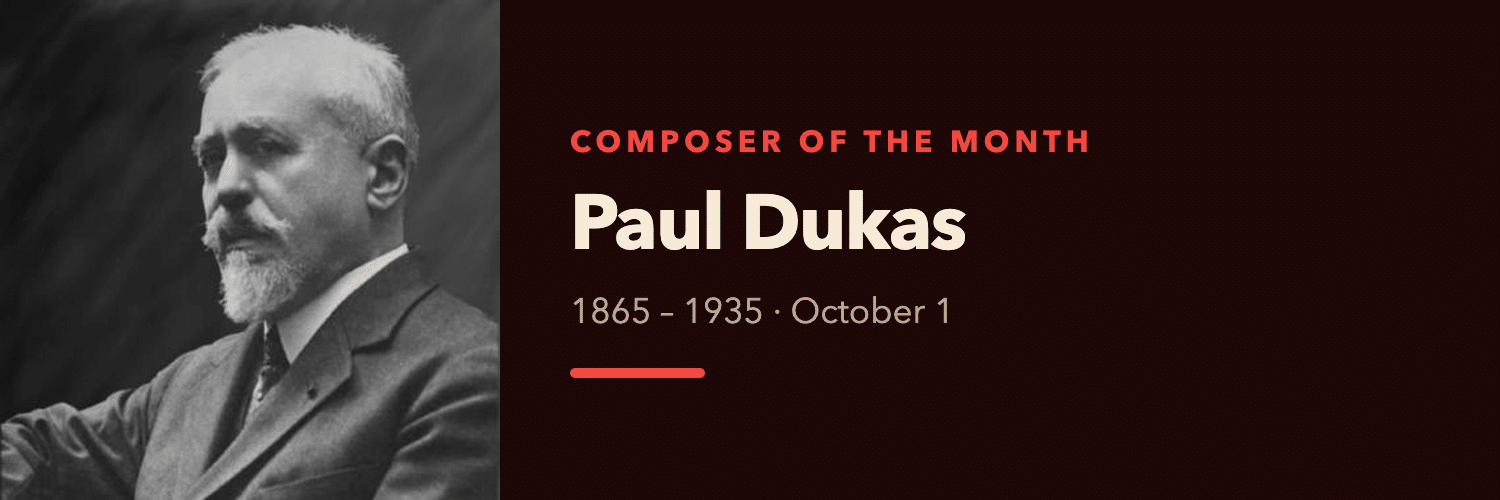
Paul Dukas is our October Composer of the Month. There is a good chance your child already knows his most famous piece of music without knowing his name, because it is the one with the broomstick.
The Piece You Already Know
Dukas was born in Paris on October 1, 1865. In 1897, when he was thirty-one, he wrote The Sorcerer’s Apprentice and conducted its first performance himself.
He took the story from a poem Goethe had written exactly one hundred years earlier. An old sorcerer leaves his young apprentice with a chore: fill the water basin. The apprentice is impatient, so he uses a spell he has overheard to bring a broomstick to life and make it carry the buckets for him.
It works beautifully. The only problem is that he never learned the words to make it stop. He tries to stop the broom himself and ends up with two brooms instead of one, both of them fetching water. The workshop floods. Then the master comes home, says the right words, and the broom goes quietly back to its corner.
Disney animated it in Fantasia in 1940, with Mickey Mouse as the apprentice. Dukas never got to see it.
Listening With Your Child
This is one of the best pieces of orchestral music to listen to with a young child, because you can follow the whole story with your ears. It runs about ten minutes.
Listen for the broom. When the spell works, a low, lumbering tune starts up in the bassoon. That tune is the broom. Ask your child to put a hand up every time it comes back.
Listen for the moment it goes wrong. The broom’s tune arrives twice at once, and then more. Ask your child how the music tells you there are more brooms now, when nobody has said a word.
Listen for the flood. The music gets faster, louder and more crowded as the water rises. Ask whether it feels like the room is filling up.
Listen for the master. When he returns, the music stops almost dead. Ask your child what that silence means, and why Dukas might have chosen to make the loudest part of the piece end so suddenly.
That last question is a real composition lesson, and children answer it better than adults do.
The Teacher Behind a Lot of Music You Know
Dukas spent much of his life teaching. He ran the orchestration class at the Paris Conservatoire from 1910 to 1913, and from 1927 until his death in 1935 he was professor of composition there. He also taught at the École normale de musique in Paris.
His students are the surprising part. Olivier Messiaen studied with him. So did Maurice Duruflé. And two of the most important composers in the guitar’s entire repertoire came out of his teaching: Joaquín Rodrigo, who wrote the Concierto de Aranjuez, and Manuel Ponce, who wrote much of the music Segovia played.
For a school that teaches guitar, that is a direct line. A student here working on Ponce is playing music written by someone who sat in Paul Dukas’s classroom.
He Kept Only What He Thought Was Finished
Dukas held himself to a standard most composers would find unbearable. He wrote a great deal and published very little, throwing away anything he did not think was genuinely finished. Barely a dozen of his works survive.
There is something worth telling a student in that. He was not a composer who published everything and hoped. He worked on things until they were right, and the small number of pieces that made it through are still played a century later.
Beyond The Sorcerer’s Apprentice, two of them turn up constantly: the fanfare from his ballet La Péri, which brass sections everywhere play, and a short piece called Villanelle that he wrote as an exam piece for the Conservatoire horn students and which horn players still play today.
Try This at Home
The broom has its own tune. That is the whole trick of the piece: give a character a short melody, and the audience knows who has walked into the room without being told.
After you have listened, try this together:
- Pick something in your house that moves. The kettle, the dog, the washing machine, someone coming down the stairs.
- Make up a short tune for it. Four or five notes is plenty.
- Play or sing it loudly when that thing is busy, and quietly when it is resting.
- See whether anyone else in the house can guess what the tune is about.
If your child plays an instrument, they can do all of this on it. If they do not, humming works perfectly well. Dukas’s broom is only a handful of notes, and it has been recognizable for a hundred and twenty-nine years.
Book a free trial lesson at The California Conservatory of Music today!
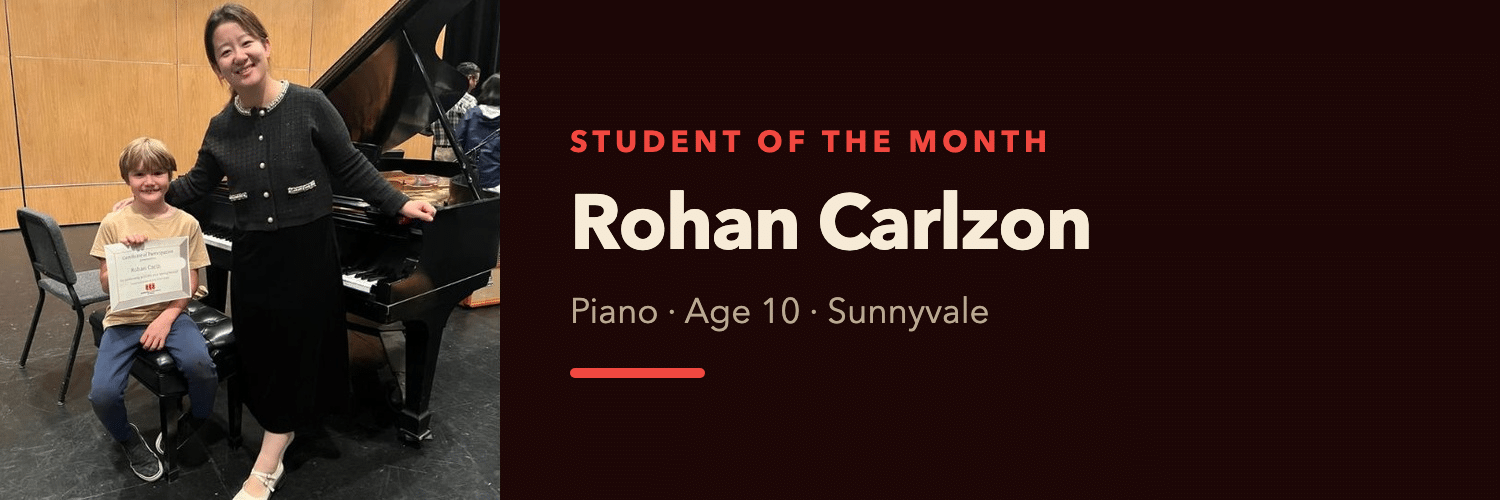
Rohan Carlzon is our Student of the Month for October. He is ten, he studies piano with Dr. Chelsea at our Sunnyvale location, and he has been with us for about two and a half years.
We sat him down with a few questions.
Student of the Month Questionnaire – Rohan Carlzon
How long have you been taking piano lessons?
“About two and a half years.”
What is your favorite thing about playing piano?
“Some songs sound harder than they are, and it’s always nice to play cool music.”
What piece are you looking forward to learning someday?
“Moonlight Sonata by Beethoven.”
What advice would you give a piano student just starting out at CCM?
“Practice more than I did.”
Do you play any sports, or do anything else outside music?
“I skateboard, rock climb, and I play chess. I also like video games and to play D&D.”
Do you have a pet?
“I have… the one guppy that survived… THE FISH PLAGUE.”
What is your favorite food?
“SUSHI.”
What do you want to be when you grow up?
“I want to be an astrophysicist or a computer scientist.”
Parent Spotlight – Imane Chraibi Carlzon
We also asked Rohan’s mother about the last two and a half years.
What are you most proud of Rohan accomplishing?
“Seeing him enjoy decoding music, and get into creating melodies.”
Why did you decide to give your child a musical upbringing?
“Music is so central in our family life yet none of us is a musician. I now regret giving up on piano after struggling with decoding music, and I want him to have this skill that can bring him joy anytime in life.”
What advice would you give a new parent starting in the program?
“There are weeks with a lot of practice, and weeks with less, and it’s fine. Our mantra is to just keep showing up to class week after week. It is also worth discussing with the teacher what kind of music your child is into, or let them explore composition if that’s what they are curious about. That flexibility went a long way for Rohan.”
Congratulations, Rohan
Two and a half years in, writing his own melodies, with the Moonlight Sonata somewhere ahead of him. That is a very good place to be at ten.
Congratulations from all of us at The California Conservatory of Music, and our thanks to Dr. Chelsea.
Book a free trial lesson at The California Conservatory of Music today!
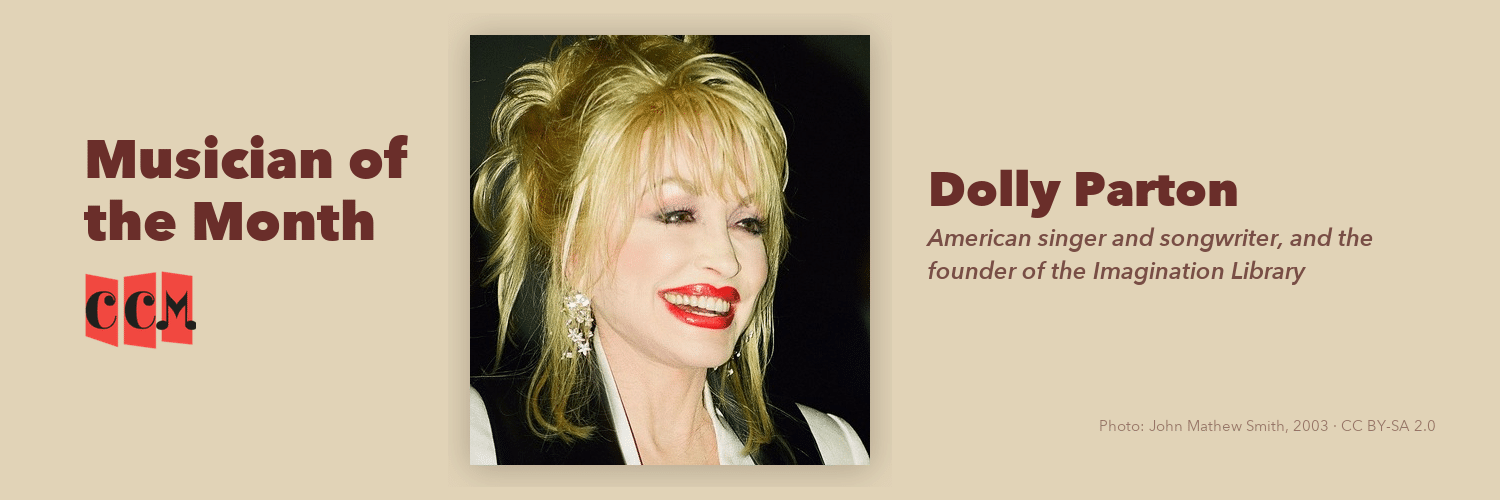
Dolly Parton is our September Musician of the Month. Dolly passed away in August at the age of 80, and this month we’re introducing our students and families to her songs, her love of storytelling, and her work bringing books to young children.
A Childhood Filled with Music
Dolly grew up in the mountains of East Tennessee, the fourth of twelve children. Her family had little money, but music was part of everyday life. Her mother sang to her, and the songs she heard growing up helped shape her own writing.
Dolly began making up songs before she could write them down. For parents who hear their children inventing tunes at the piano or singing made-up songs around the house, that might sound familiar!
Those little experiments are worth encouraging. Alongside practicing their lesson music, children can explore their instruments and try out their own ideas. They don’t have to wait until they can read music or play a whole piece to create something.
Stories You Can Hear in the Music
One of Dolly’s best-known songs, Coat of Many Colors, tells the story of a coat her mother made for her from pieces of fabric, telling her the story of Joseph’s coat so she would be proud to wear it. The other children laughed at it anyway, and Dolly has said it took her years, and writing the song, to put that behind her. She has called it the most personal thing she ever wrote.
It’s a good starting point for listening as a family. The story is easy to follow, and it gives children something to think about: why do we treasure certain things, and how can we be kinder to one another?
Two other songs to explore are Jolene and I Will Always Love You. In Jolene, listen for the repeating guitar pattern. Can your child tap along with the steady beat? In Dolly’s recording of I Will Always Love You, notice how her voice changes from one phrase to the next. Where does she sing gently, and where does the sound grow?
For students, these are useful things to notice in their own playing, too. Learning the notes is one part of a piece. Deciding how to shape them is another.
Sharing a Love of Books
In 1995, Dolly started the Imagination Library, inspired by her father, who never learned to read or write. She wanted more children to grow up with books of their own.
The program sends a free book each month to enrolled children under five in participating communities. With funding shared by Dolly and local community partners, it grew from a program in her home county to one serving children in the United States, Canada, the United Kingdom, Australia, and Ireland. It has now given away more than 332 million books.
For a young child, getting a book in the mail with their name on it can be a big event. And reading it together gives families a chance to slow down, ask questions, and enjoy a story.
Try Some Songwriting at Home
Dolly often found ideas in her own experiences. Students can try that, too.
After listening to Coat of Many Colors, ask your child to think of a favorite memory, a person they love, or an object that’s special to them. Then try these steps together:
- Say two short lines about it.
- Clap a steady beat while saying the words.
- Try singing the words to a made-up tune.
- If you’d like, add a few notes on an instrument.
The song doesn’t have to rhyme, and it doesn’t need to be finished in one sitting. If your child likes what they’ve made, record it so they can hear it again or share it with their teacher.
Dolly started making songs long before she had an audience. For a young musician, a few words and a tune are a perfectly good place to begin.
Book a free trial lesson at The California Conservatory of Music today!
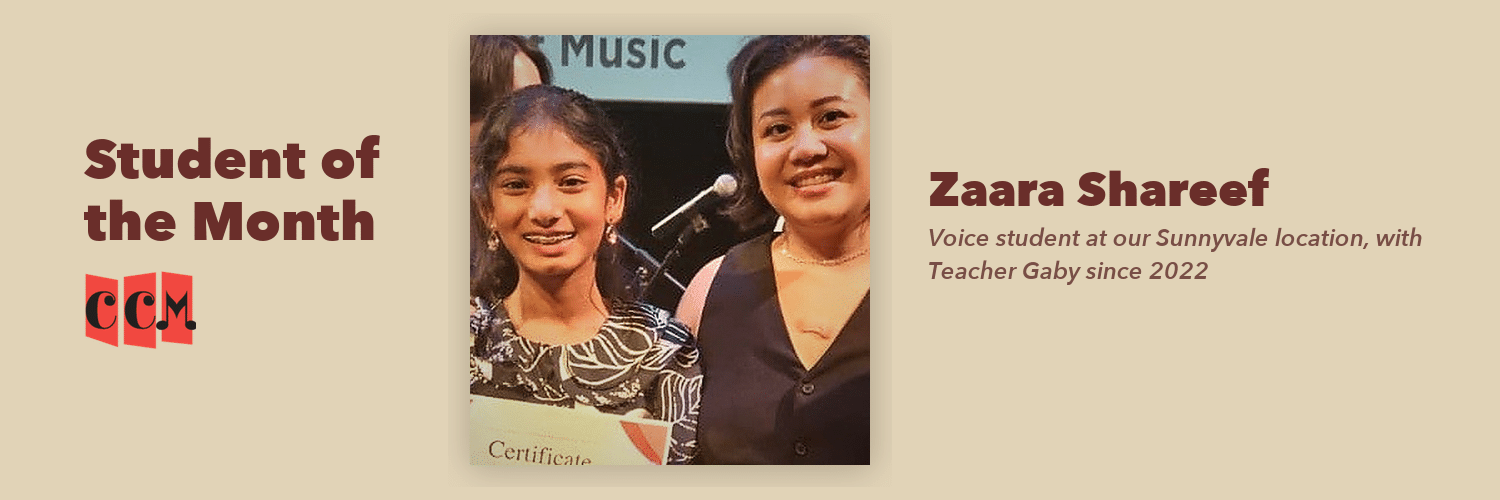
This September we are delighted to feature Zaara Shareef as our Student of the Month! Zaara has been taking voice lessons at our Sunnyvale location for four years, since 2022, with Teacher Gaby.
She sang “Skyfall” at a recent recital, and several parents went out of their way afterward to tell her family how much they had enjoyed it. Ask Zaara what she likes most about singing and she will tell you it is discovering new ways to improve her voice, which is a fairly serious answer from an eleven-year-old.
Read more about Zaara’s experience at CCM below!
Student of the Month Questionnaire – Zaara Shareef
What is your name?
Zaara Shareef.
How old are you?
I am 11 years old.
Who is your teacher?
Ms. Gaby.
How long have you been taking voice lessons?
Four years, since 2022.
What advice would you give to a voice student just starting out at CCM?
To always arrive to your lesson on time and always practice after your lessons!
What piece are you looking forward to learning someday?
Not a particular piece, but I want to try different varieties of songs.
What is your favorite thing about voice lessons and singing?
Discovering new ways to improve my vocal skills.
What is your favorite food?
Burritos.
Do you have a pet?
Yes, I have two cats.
Do you play any sports or do any other activities outside of music lessons?
Yes, I play the piano and I enjoy playing volleyball.
What do you want to be when you grow up?
I want to be either a lawyer, a governor, or the U.S. President.
What is your most memorable experience at CCM?
I love the recitals. I especially love how all the parents clap for me at the end. It makes me feel I did an awesome job, which I always do.
Parent Spotlight – Nuzhath Jahan
Regarding voice instruction, what are you most proud of your child accomplishing?
I am incredibly proud of how Zaara’s voice skills have grown. Her recent recital performance of “Skyfall” was wonderful, and it was touching when several parents shared their appreciation for her singing afterward.
What advice would you give a new parent starting in the program?
Encourage your child to practice regularly, even for a few minutes a day. With consistent practice and encouragement, they’ll build confidence and see improvement over time.
Why did you decide to give your child a musical upbringing?
I’ve always loved music, but I never got the chance to learn it myself. So I wanted my kids to have that opportunity — to not only enjoy music, but learn it, grow through it, and hopefully bring joy to others through their music.
Congratulations, Zaara!
Book a free trial lesson at The California Conservatory of Music today!

A four-year-old spent a summer at her grandfather’s farm in New Hampshire, where there was no piano. She composed three waltzes anyway. She held them in her head until the family went home, sat down at the keyboard, and played them.
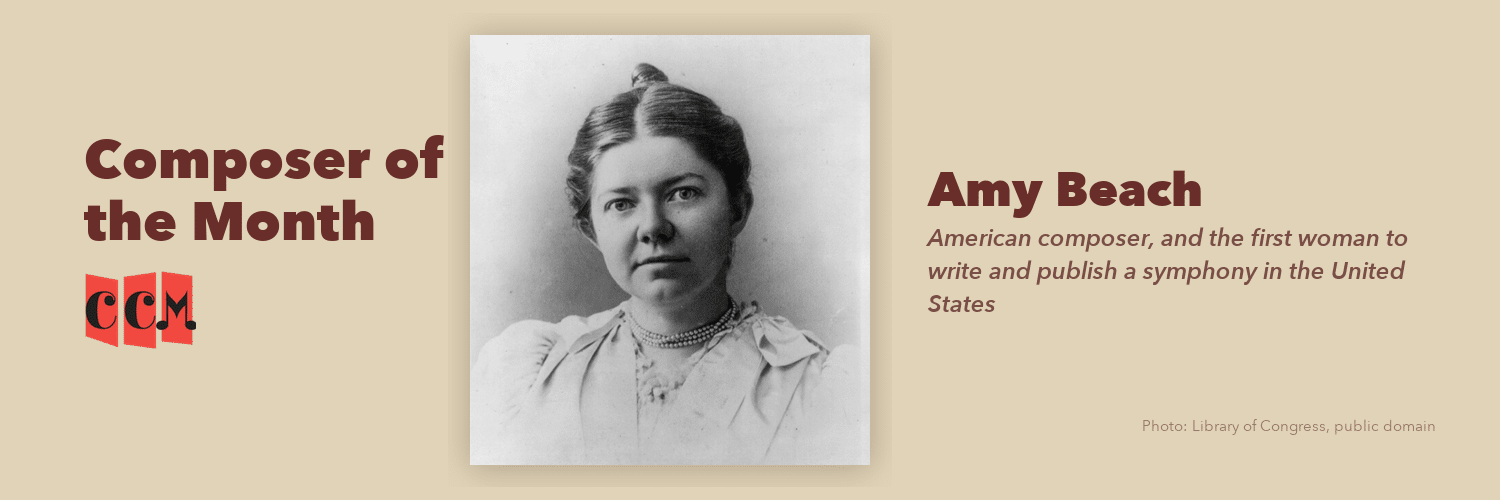
Amy Beach is our Composer of the Month for September. By the time anyone thought to give her lessons, she had been composing for years.
Early Life and Inspirations
She was born Amy Marcy Cheney on September 5, 1867, in Henniker, New Hampshire, into a family that noticed early what they had.
At two she was improvising harmony against the tunes her mother sang, singing a second line underneath rather than copying the first. At three she taught herself to read. At four came the waltzes composed away from any instrument, which is the detail that tells you the most about her. She was not working things out with her hands. She was hearing them.
This is worth sitting with, because it is the thing we tell parents about young children and music. The ear arrives before the technique does, and often long before anyone is formally taught anything. Beach simply had an unusually clear example of it.
The Symphony No American Woman Had Written
On October 30, 1896, the Boston Symphony Orchestra gave the premiere of her Symphony in E minor, the piece everyone calls the Gaelic Symphony. It was the first symphony written and published by an American woman.
She had been drawn to a collection of old Gaelic folk tunes and described being taken by their simple, rugged, unpretentious beauty. She built a full symphony out of that interest, at a time when a great many people believed American composers had to study in Europe to be taken seriously.
Beach never did. She is generally counted as the first American classical composer to reach that level without a European training behind her, and audiences in Europe took to her music anyway.
Teaching Herself
Here is the part that surprises most musicians. Amy Beach had one year of formal composition lessons, in Boston, and that was all.
After that she built her own course of study. She got hold of scores and worked through them systematically, in her words: “I copied and memorized whole scores of symphonies.” She translated treatises on orchestration for herself. She learned how a symphony was made by taking symphonies apart.
Her circumstances shaped the choice. She married Dr. Henry Harris Aubrey Beach in 1885, and as a married woman of her time and class she agreed to limit her public performing, appearing roughly once a year and giving the proceeds to charity. Composition became the work she could do without restriction, and she did an enormous amount of it, more than 150 numbered pieces across songs, chamber music, choral works and orchestral scores.
She returned to the concert stage in her forties and toured widely, playing her own music to audiences on both sides of the Atlantic. She kept composing until the end of her life in 1944.
What Students Can Learn from Amy Beach
Two things in her story are worth passing to a young musician.
The ear leads. A child who can hold a tune in her head, turn it over, and change it is already composing, whether or not she can write a note of it down. Beach did this at four in a house with no piano. Encourage the humming, the making things up, the playing by ear. That is not a detour from real musicianship. It is the foundation of it.
Curiosity beats credentials. One year of lessons and a lifetime of taking scores apart produced a symphony the Boston Symphony premiered. Students sometimes believe there is an official path and that missing it settles the question. Beach is the counterexample. She wanted to know how the music worked, so she found out.
Start Listening
Begin with The Year’s at the Spring, a setting of Robert Browning that became one of the best-loved American songs of its era. It is short, immediately appealing, and within reach of many voice students. Its companion, Ah, Love, but a Day, is the other Browning setting worth knowing.
Violinists should go to the Violin Sonata in A minor, written the same year the Gaelic Symphony was premiered. It is full-blooded Romantic writing and it deserves to be played far more often than it is.
Then the Gaelic Symphony itself, for the scale of the thing, and the Piano Quintet in F sharp minor if you want to hear her at her most concentrated.
Listen for how she handles a melody she did not write. In the Gaelic Symphony the folk tunes are never merely quoted and decorated. They get pulled into the argument of the piece and changed by it, which is a much harder thing to do and a good deal more interesting to follow.
Much of her music is available through IMSLP, and there are now excellent recordings of the symphony, the concerto and the chamber works.
Book a free trial lesson at The California Conservatory of Music today!
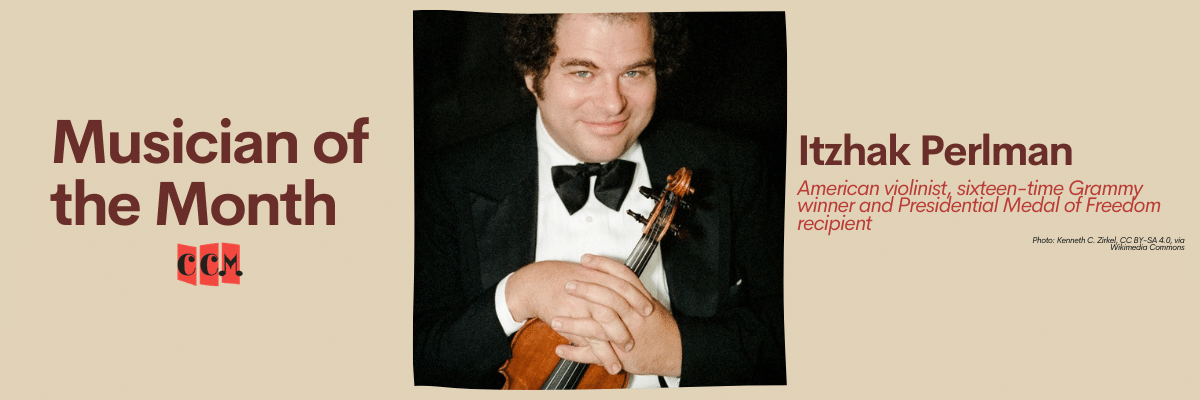
Our August Musician of the Month turns 81 on August 31. Itzhak Perlman heard a violin on the radio when he was three years old and decided that was the instrument. A year later he caught polio. He has played sitting down ever since, and for six decades he has been one of the most recognizable living violinists.
Early Life and Inspirations
He was born in Tel Aviv in 1945 to parents who had emigrated from Poland. Neither was a musician. The radio did the recruiting.
He was turned away from the Shulamit Conservatory for being too small to hold a violin properly, so he taught himself on a toy instrument until they relented. He studied at the Academy of Music in Tel Aviv with Rivka Goldgart from the age of five, and gave his first public concert at ten.
The polio arrived when he was four and left his legs permanently affected. He performs seated and uses crutches or a scooter to get to the chair. His disability is not a prelude to the music or a problem the story needs him to overcome. It is simply part of how he performs, as it has been throughout his public career.
The Ed Sullivan Show and What Came After
In 1958, at thirteen, he appeared on The Ed Sullivan Show in front of an American television audience of millions. The family moved to New York shortly afterward, and he entered Juilliard to study with Ivan Galamian and Dorothy DeLay, two of the most influential violin teachers of the second half of the twentieth century.
His Carnegie Hall debut came in 1963. The following year he won the Leventritt Competition, the breakthrough that launched his international career in earnest.
He has since collected sixteen Grammy Awards and four Emmys. He received the Medal of Liberty in 1986, the National Medal of Arts in 2000, the Kennedy Center Honors in 2003, and the Presidential Medal of Freedom in 2015. That last citation named him not only as a musician but as an important voice on behalf of people with disabilities. He has spent decades pushing concert halls to be places that disabled audiences and disabled performers can actually get into.
The Voice Behind the Films
If you have never been to a classical concert, you have almost certainly still heard him play.
The violin solos in Schindler’s List are his. So are the ones in Memoirs of a Geisha. John Williams hoped Perlman would play the central violin part, and the sound of that recording is restrained, unhurried and never showy. It is a fair introduction to what he does.
He plays the 1714 “Soil” Stradivari, which previously belonged to Yehudi Menuhin. He acquired it from Menuhin in 1986 and has played it ever since.
Teaching has also become a central part of his work. He has held the Dorothy Richard Starling Chair in violin at Juilliard since 2003, and he and his wife Toby run a summer program for string players aged twelve to eighteen on Shelter Island in New York.
What Students Can Learn from Itzhak Perlman
The Perlman Music Program has a phrase we like a great deal: connection over competition. Admission is based on musical ability, and even the orchestra seating is noncompetitive and regularly rotated, so students experience both leading and supporting roles. The whole design encourages young musicians to become collaborators rather than rivals. Coming from someone whose career has included nearly every major musical honor, that is worth paying attention to.
The other lesson is about tone. Perlman is a formidable technician, but what many listeners remember first is not his speed. It is the warmth of the sound. Students often assume the impressive thing is velocity. It almost never is.
Start Listening
Start with the Schindler’s List theme, because you will recognize it and because it shows what he can do with a very simple line.
Then the Beethoven Violin Concerto for the full-scale version of him, and the Mendelssohn Piano Trios he recorded with Yo-Yo Ma and Emanuel Ax if you want to hear him listening to other players rather than leading.
And if you would like to hear him somewhere unexpected, find In the Fiddler’s House, his klezmer recordings. He is unmistakably himself on them, and clearly having the time of his life.
Sign up for a FREE introductory lesson at The California Conservatory of Music today!
Every week, a parent asks us some version of the same question. Their child’s week is already full—school, homework, soccer, dinner, bed. Does music actually do anything for them, or is it one more thing?
The short answer is yes, though not necessarily for the reasons you’ve heard. You’ve seen the headlines: music lessons raise IQ; music students do better in math and science. There is research behind those claims, and it would be convenient for us to point to it and move on. But the evidence is less conclusive than the headlines suggest. Compare children taking music lessons with children participating in another structured activity—a sport, a second language, a chess club—and much of the apparent cognitive advantage disappears. Families who enroll their children in lessons often differ in ways that have nothing to do with music.
Here is what the research does support, and what we have seen ourselves across fifteen years of teaching.
Music students do better in math and science
The largest study on this followed 112,916 students through high school. Those who took instrumental music scored significantly higher in Grade 10 mathematics and science, and in English.
What makes the study unusual is how hard the researchers worked to rule out the obvious objection. The association held after the researchers accounted for earlier academic performance, language and cultural background, and neighborhood socioeconomic status. Those controls make the finding more persuasive, though an observational study cannot prove that the lessons caused the higher scores.
The effect was strongest for students who played an instrument rather than sang, and it grew with how long and how seriously they were involved.
A separate analysis using data from the large American ABCD Study found that children consistently engaged in music training for two years scored higher on several cognitive and language tasks, with the clearest gain over time appearing in picture vocabulary.
What a randomized trial found about IQ
Correlations are one thing. The stronger test is to assign children to lessons at random, and that has been done.
Researchers at the Royal Conservatory of Music in Toronto took 144 six-year-olds and randomly assigned them to keyboard lessons, voice lessons, drama, or no lessons at all, for 36 weeks. Every group gained IQ over the year, since all of them had started school. But the children who received music lessons gained about three points more than those who did not.
It is a modest number and the study is one of its kind, so we would not want to oversell it. But it is a properly randomized trial published in a leading journal, and it points the same direction as everything else here.
Reading starts with the ear
Before a child can read a word, they have to hear that it is made of separate sounds. That skill, phonological awareness, is one of the strongest predictors of how easily a child learns to read, and music training improves it.
A meta-analysis of thirteen studies found a small but statistically reliable gain. Its model suggested roughly forty hours of training might be needed before a reliable effect appeared in rhyming skills, though the authors urged caution about that figure. It did not find a statistically reliable overall improvement in reading fluency. For children with dyslexia specifically, a randomized trial with a proper comparison group, though a relatively small one, found that rhythm-focused music training improved phonological awareness and reading accuracy. The proportion of children still classified as very poor text readers was roughly half that of the comparison group.
Hands and ears, measured
These are the least-discussed benefits and the best evidenced.
Manual dexterity and two-handed coordination. Children who learn an instrument improve on standard tests of fine motor skill. In one study, which used group-based music training rather than private lessons, the gains were still present four months after the training ended. A separate two-year randomized school trial also found improvements in fine motor skill and auditory memory, though it did not produce broad gains across every outcome it measured.
Hearing. Trained musicians discriminate pitch far more finely than untrained listeners, and performed better on one study’s attentive sound-tracking task, with the groups matched for IQ. Worth knowing: the same study found no advantage in understanding speech against competing talkers or background noise.
Fine motor control and careful listening are valuable in their own right, whatever a child eventually chooses to do.
What fifteen years has shown us
Research can tell you what happens on average. It cannot tell you what a Tuesday afternoon looks like. This part is ours.
Five minutes is enough to start. Parents rarely believe this. A young beginner practicing five careful minutes a day will get further than one practicing thirty distracted ones. We say practice makes permanence, not practice makes perfect, because whatever a student repeats is what they learn, mistakes included. The research agrees here: when practice is measured properly rather than self-reported, sheer quantity barely predicts the quality of the playing.
Showing up matters more than the length of the session. We run practice challenges for exactly that reason. Thirty days earns a ribbon and a certificate, fifty earns a medal, and a hundred days earns a trophy and a name on our Wall of Fame.
Progress rarely looks like progress. The signs parents tend to watch for, playing faster and louder and moving through the book, are the ones teachers trust least. The real markers are quieter. A child who stops at a mistake and works on that one measure instead of restarting the whole piece is practicing well, even though it sounds worse from the next room. A child who has become fussier about their own playing has not got worse. They have started hearing things they could not hear a year ago.
Milestones do not run on a schedule. Parents often arrive wanting to know when their child should be reading music, or playing with both hands, or performing from memory. We understand the impulse, but the honest answer is that every child arrives at these things on their own timeline, and a child who is slower to one is frequently quicker to the next. What we can say with confidence is that time spent early on posture and technique is the best investment available. Students who are set up properly at the beginning learn faster for years afterward, and students who are rushed spend that time later undoing habits instead.
What makes a beginner take off is remarkably consistent. Practice happens daily, even briefly. Lessons happen every week rather than when the calendar allows. Home is encouraging about it. And in the early years, a parent sits in on the lesson and helps at home during the week, which does more than almost anything else we could ask for.
Where it can lead
Our students have won the Guitar Foundation of America’s Junior, Senior and International competitions, and the Parkening Competition. They have performed on NPR’s From the Top and Tiny Desk, been recognized by YoungArts, and have organized their own fundraisers raising thousands of dollars for charity.
We mention this not because we expect any of it from a beginner, but because it is the honest ceiling of what a music education can become when a young person and a good teacher stay with it.
What students take with them
The ones who stay through high school tend to leave with four things.
Music becomes part of their college application, and in an admissions process where thousands of strong students look interchangeable on paper, years of serious musical work is a genuine differentiator. They keep a relationship with their teacher that often outlasts the lessons themselves. They take the instrument with them when they go. And they find their people, because musicians tend to locate each other quickly wherever they land.
None of that shows up in a study. It is simply what we have watched happen.
Common questions
Do music lessons help with math?
The largest study on the question, following 112,916 students, found that those who took instrumental music scored higher in Grade 10 mathematics and science, with the advantage holding after family background and prior achievement were taken into account.
Do music lessons make children smarter?
A randomized trial of 144 six-year-olds found that a year of music lessons produced a gain of about three IQ points over children who did not take them. Researchers continue to debate how much of the wider academic advantage is caused by lessons and how much reflects who chooses them, but the association itself is consistent and large.
What age should a child start?
Earlier is not automatically better, and the evidence for a hard cutoff is much weaker than it is usually presented. Professional musicians in one large study had started anywhere between the ages of two and eighteen. In practice the right moment is when a child is curious and can sit with an adult for a few minutes at a time. We teach students from age four.
How long should my child practice each day?
Less than you think, especially at the start. Five minutes of careful work is genuinely enough for a young beginner. Their teacher will tell you when it should grow.
Which instrument should we start with?
The one your child is drawn to. Interest predicts whether they keep playing better than almost anything else we can measure. We teach guitar, piano, violin and voice, and we are happy to talk it through before you commit to anything.
Is it too late for my child to start?
Almost certainly not. Adults learn instruments successfully all the time, and so do teenagers who have never touched one.
Coming to see us
The California Conservatory of Music has taught guitar, piano, violin and voice for fifteen years, in Sunnyvale, Fremont and Redwood City, to students from age four through to adults picking up an instrument for the first time.
The research above is encouraging, but it is not really why families stay. They stay because a child who could not play anything in September plays something in June, and because standing up in front of a room and doing it well changes how a young person carries themselves.
If you would like to see what that looks like, we offer a free introductory lesson.
Where this comes from
Claims about research should be checkable, so here is what the above rests on.
- Guhn, Emerson & Gouzouasis, “A Population-Level Analysis of Associations Between School Music Participation and Academic Achievement,” Journal of Educational Psychology, 2020. The 112,916-student study.
- Schellenberg, “Music Lessons Enhance IQ,” Psychological Science, 2004. The randomized trial.
- Habibi et al., Annals of the New York Academy of Sciences, 2025. The ABCD Study analysis, nearly 12,000 children.
- Gordon, Fehd & McCandliss, Frontiers in Psychology, 2015. Phonological awareness meta-analysis.
- Flaugnacco et al., PLoS ONE, 2015. The randomized trial in children with dyslexia.
- Martins et al., Frontiers in Psychology, 2018, and Neves et al., Cognition, 2025. Motor skill and auditory memory.
- Madsen, Marschall, Dau & Oxenham, Scientific Reports, 2019. Pitch discrimination.
- Duke, Simmons & Cash, Journal of Research in Music Education, 2009. What effective practice actually looks like.
Sign up for a FREE introductory lesson at The California Conservatory of Music today!