July 1, 2026
Gustav Mahler: July Composer of the Month

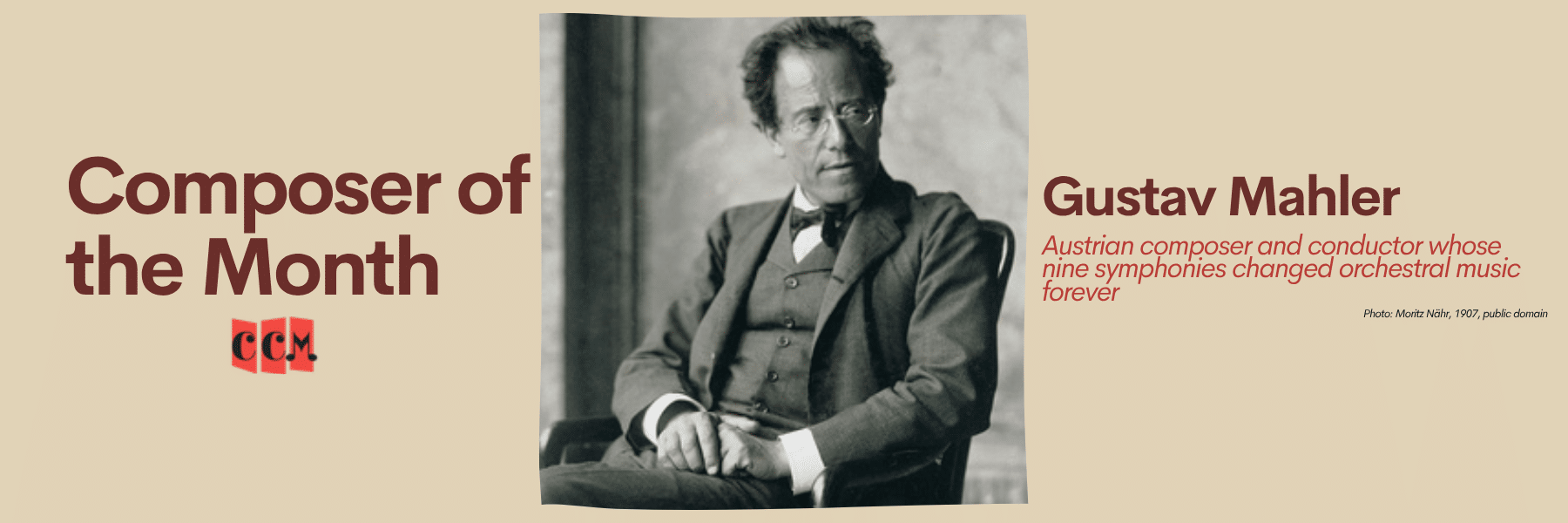
Our July Composer of the Month was born on July 7, 1860: Gustav Mahler — the most famous conductor of his age, who wrote some of the biggest music ever composed, entirely during his summer vacations.
Every beginning music student knows Frère Jacques. Mahler is the composer who dared to put it in a symphony: slowed down, shifted into a minor key, turned into a strange, haunting funeral march. Audiences in 1889 didn’t know what to make of it. Today it’s one of the most famous movements in orchestral music, and it tells you everything about him. Mahler took the simple tunes everyone knew and built cathedrals out of them: folk songs, marches, birdsong, children’s rounds.
Early Life and Inspirations
Mahler grew up in a Bohemian village, the son of an innkeeper, in a family that knew real hardship. Around age four he discovered a piano in his grandparents’ attic, and he essentially never came back down. By ten he was performing publicly; at fifteen he was admitted to the Vienna Conservatory. The sounds of his childhood — village bands, military bugle calls, folk dances, church bells — never left him. Decades later, they surface constantly in his symphonies, sometimes tenderly, sometimes twisted into something darker.
The Busiest Musician in Europe
Mahler’s day job would have consumed three ordinary careers. He climbed the ladder of European opera houses one podium at a time until, in 1897, he won the most powerful position in classical music: director of the Vienna Court Opera. He held it for ten years, conducting more than six hundred performances and driving singers, orchestras, and stage designers toward a standard of perfection that made him admired, feared, and imitated across Europe.
Which left exactly one season for composing: summer. Mahler built himself a series of tiny one-room composing huts: one in a lakeside meadow, one in the woods above another lake, one in the Dolomites. Every July and August he retreated there at dawn to write. Nine completed symphonies and some of the greatest songs in the repertoire came out of those sheds. The man conducted an empire ten months a year and still made time for the work that mattered most to him. There’s a practice-schedule lesson in there somewhere.
Triumph and Heartbreak
Mahler’s music asks enormous questions, about love, death, nature, and what comes after, because his life kept asking them of him. In a single devastating year, 1907, he lost his four-year-old daughter, was diagnosed with the heart condition that would eventually take him, and left Vienna. He crossed the Atlantic to conduct in New York, at the Metropolitan Opera and the New York Philharmonic.
He got one unqualified triumph before the end. In September 1910, in Munich, he conducted the premiere of his colossal Eighth Symphony, nicknamed the “Symphony of a Thousand” for the sheer number of performers it requires, before an audience of three thousand. The ovation went on for half an hour. Eight months later he was gone, at just fifty.
“My time will yet come,” he had once insisted, when critics dismissed his music as excessive. He was right. Half a century after his death, a generation of conductors, Leonard Bernstein above all, put Mahler at the center of the orchestral repertoire, where he has remained ever since. Today, more than a century later, his symphonies sell out concert halls faster than almost anything else written for orchestra.
What Students Can Learn from Mahler
Two things. First: big feelings belong in music. Mahler put grief, joy, terror, and wonder into his work without apology, and that honesty is exactly what audiences love him for. Second: the busiest person you know still has summers. Mahler wrote nine symphonies on vacation, in a shed, before breakfast. Twenty minutes of practice a day suddenly sounds achievable.
Start Listening
- Symphony No. 1, third movement — the Frère Jacques funeral march. Play it for your kids; watch their faces when they recognize the tune.
- Adagietto from Symphony No. 5 — written as a love letter to his wife, Alma. Strings and harp alone, and one of the most beautiful things ever composed.
- Symphony No. 2, “Resurrection,” finale — the closest an orchestra gets to the sky opening up.
- Symphony No. 8, opening — the “Symphony of a Thousand” erupting into Veni creator spiritus. The 1910 premiere audience lost its mind; you might too.
Mahler wrote some of his most beautiful music for singers. If someone in your family loves to sing, our voice program is a great place to start.
Sign up for a FREE introductory lesson at The California Conservatory of Music today!