October 7, 2026
Paul Dukas: October Composer of the Month

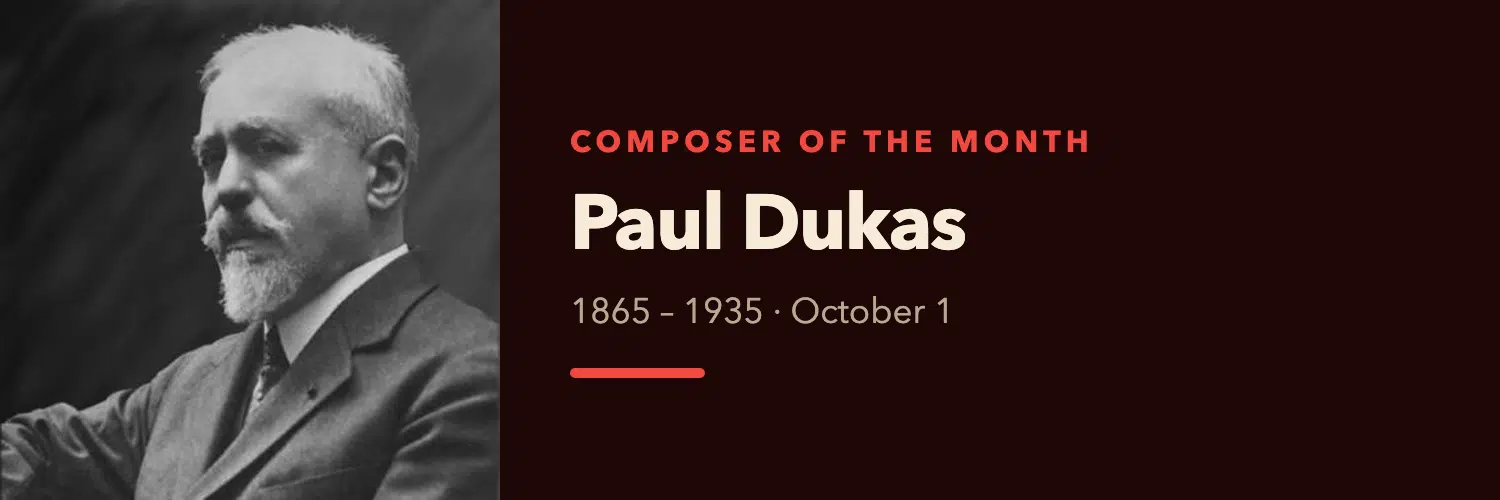
Paul Dukas is our October Composer of the Month. There is a good chance your child already knows his most famous piece of music without knowing his name, because it is the one with the broomstick.
The Piece You Already Know
Dukas was born in Paris on October 1, 1865. In 1897, when he was thirty-one, he wrote The Sorcerer’s Apprentice and conducted its first performance himself.
He took the story from a poem Goethe had written exactly one hundred years earlier. An old sorcerer leaves his young apprentice with a chore: fill the water basin. The apprentice is impatient, so he uses a spell he has overheard to bring a broomstick to life and make it carry the buckets for him.
It works beautifully. The only problem is that he never learned the words to make it stop. He tries to stop the broom himself and ends up with two brooms instead of one, both of them fetching water. The workshop floods. Then the master comes home, says the right words, and the broom goes quietly back to its corner.
Disney animated it in Fantasia in 1940, with Mickey Mouse as the apprentice. Dukas never got to see it.
Listening With Your Child
This is one of the best pieces of orchestral music to listen to with a young child, because you can follow the whole story with your ears. It runs about ten minutes.
Listen for the broom. When the spell works, a low, lumbering tune starts up in the bassoon. That tune is the broom. Ask your child to put a hand up every time it comes back.
Listen for the moment it goes wrong. The broom’s tune arrives twice at once, and then more. Ask your child how the music tells you there are more brooms now, when nobody has said a word.
Listen for the flood. The music gets faster, louder and more crowded as the water rises. Ask whether it feels like the room is filling up.
Listen for the master. When he returns, the music stops almost dead. Ask your child what that silence means, and why Dukas might have chosen to make the loudest part of the piece end so suddenly.
That last question is a real composition lesson, and children answer it better than adults do.
The Teacher Behind a Lot of Music You Know
Dukas spent much of his life teaching. He ran the orchestration class at the Paris Conservatoire from 1910 to 1913, and from 1927 until his death in 1935 he was professor of composition there. He also taught at the École normale de musique in Paris.
His students are the surprising part. Olivier Messiaen studied with him. So did Maurice Duruflé. And two of the most important composers in the guitar’s entire repertoire came out of his teaching: Joaquín Rodrigo, who wrote the Concierto de Aranjuez, and Manuel Ponce, who wrote much of the music Segovia played.
For a school that teaches guitar, that is a direct line. A student here working on Ponce is playing music written by someone who sat in Paul Dukas’s classroom.
He Kept Only What He Thought Was Finished
Dukas held himself to a standard most composers would find unbearable. He wrote a great deal and published very little, throwing away anything he did not think was genuinely finished. Barely a dozen of his works survive.
There is something worth telling a student in that. He was not a composer who published everything and hoped. He worked on things until they were right, and the small number of pieces that made it through are still played a century later.
Beyond The Sorcerer’s Apprentice, two of them turn up constantly: the fanfare from his ballet La Péri, which brass sections everywhere play, and a short piece called Villanelle that he wrote as an exam piece for the Conservatoire horn students and which horn players still play today.
Try This at Home
The broom has its own tune. That is the whole trick of the piece: give a character a short melody, and the audience knows who has walked into the room without being told.
After you have listened, try this together:
- Pick something in your house that moves. The kettle, the dog, the washing machine, someone coming down the stairs.
- Make up a short tune for it. Four or five notes is plenty.
- Play or sing it loudly when that thing is busy, and quietly when it is resting.
- See whether anyone else in the house can guess what the tune is about.
If your child plays an instrument, they can do all of this on it. If they do not, humming works perfectly well. Dukas’s broom is only a handful of notes, and it has been recognizable for a hundred and twenty-nine years.
Book a free trial lesson at The California Conservatory of Music today!