September 2, 2026
Amy Beach: September Composer of the Month

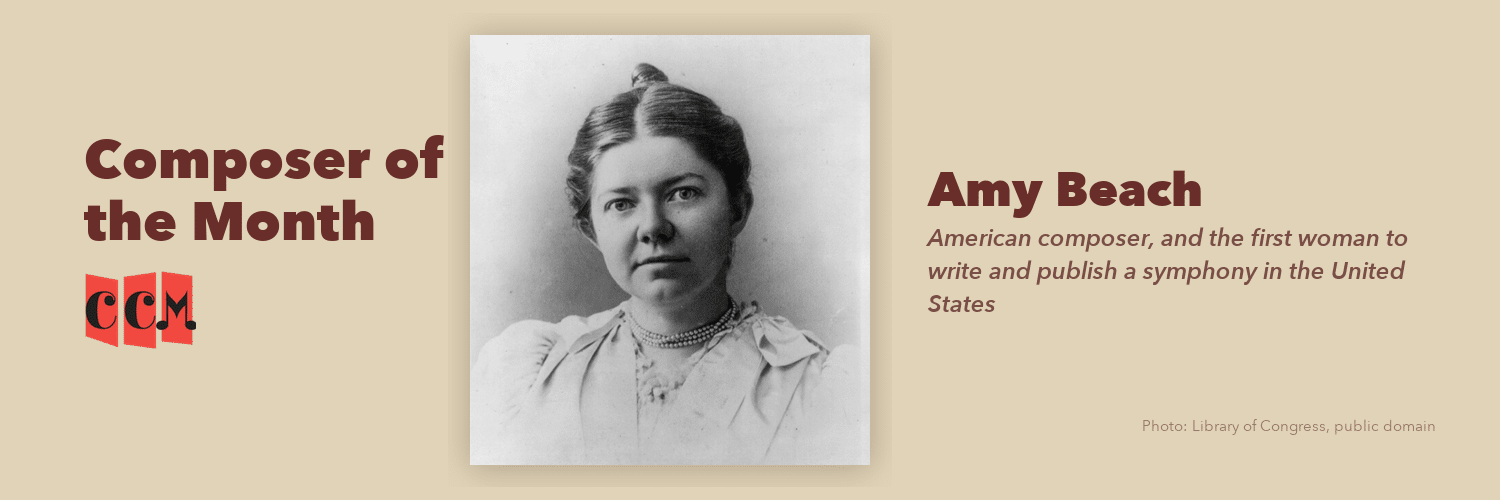
A four-year-old spent a summer at her grandfather’s farm in New Hampshire, where there was no piano. She composed three waltzes anyway. She held them in her head until the family went home, sat down at the keyboard, and played them.
Amy Beach is our Composer of the Month for September. By the time anyone thought to give her lessons, she had been composing for years.
Early Life and Inspirations
She was born Amy Marcy Cheney on September 5, 1867, in Henniker, New Hampshire, into a family that noticed early what they had.
At two she was improvising harmony against the tunes her mother sang, singing a second line underneath rather than copying the first. At three she taught herself to read. At four came the waltzes composed away from any instrument, which is the detail that tells you the most about her. She was not working things out with her hands. She was hearing them.
This is worth sitting with, because it is the thing we tell parents about young children and music. The ear arrives before the technique does, and often long before anyone is formally taught anything. Beach simply had an unusually clear example of it.
The Symphony No American Woman Had Written
On October 30, 1896, the Boston Symphony Orchestra gave the premiere of her Symphony in E minor, the piece everyone calls the Gaelic Symphony. It was the first symphony written and published by an American woman.
She had been drawn to a collection of old Gaelic folk tunes and described being taken by their simple, rugged, unpretentious beauty. She built a full symphony out of that interest, at a time when a great many people believed American composers had to study in Europe to be taken seriously.
Beach never did. She is generally counted as the first American classical composer to reach that level without a European training behind her, and audiences in Europe took to her music anyway.
Teaching Herself
Here is the part that surprises most musicians. Amy Beach had one year of formal composition lessons, in Boston, and that was all.
After that she built her own course of study. She got hold of scores and worked through them systematically, in her words: “I copied and memorized whole scores of symphonies.” She translated treatises on orchestration for herself. She learned how a symphony was made by taking symphonies apart.
Her circumstances shaped the choice. She married Dr. Henry Harris Aubrey Beach in 1885, and as a married woman of her time and class she agreed to limit her public performing, appearing roughly once a year and giving the proceeds to charity. Composition became the work she could do without restriction, and she did an enormous amount of it, more than 150 numbered pieces across songs, chamber music, choral works and orchestral scores.
She returned to the concert stage in her forties and toured widely, playing her own music to audiences on both sides of the Atlantic. She kept composing until the end of her life in 1944.
What Students Can Learn from Amy Beach
Two things in her story are worth passing to a young musician.
The ear leads. A child who can hold a tune in her head, turn it over, and change it is already composing, whether or not she can write a note of it down. Beach did this at four in a house with no piano. Encourage the humming, the making things up, the playing by ear. That is not a detour from real musicianship. It is the foundation of it.
Curiosity beats credentials. One year of lessons and a lifetime of taking scores apart produced a symphony the Boston Symphony premiered. Students sometimes believe there is an official path and that missing it settles the question. Beach is the counterexample. She wanted to know how the music worked, so she found out.
Start Listening
Begin with The Year’s at the Spring, a setting of Robert Browning that became one of the best-loved American songs of its era. It is short, immediately appealing, and within reach of many voice students. Its companion, Ah, Love, but a Day, is the other Browning setting worth knowing.
Violinists should go to the Violin Sonata in A minor, written the same year the Gaelic Symphony was premiered. It is full-blooded Romantic writing and it deserves to be played far more often than it is.
Then the Gaelic Symphony itself, for the scale of the thing, and the Piano Quintet in F sharp minor if you want to hear her at her most concentrated.
Listen for how she handles a melody she did not write. In the Gaelic Symphony the folk tunes are never merely quoted and decorated. They get pulled into the argument of the piece and changed by it, which is a much harder thing to do and a good deal more interesting to follow.
Much of her music is available through IMSLP, and there are now excellent recordings of the symphony, the concerto and the chamber works.
Book a free trial lesson at The California Conservatory of Music today!