August 31, 2026
Itzhak Perlman: August Musician of the Month

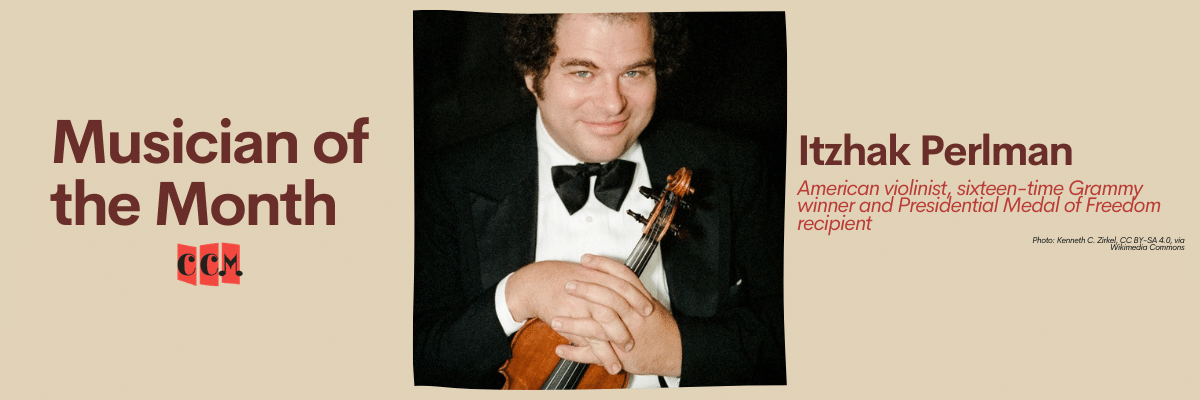
Our August Musician of the Month turns 81 on August 31. Itzhak Perlman heard a violin on the radio when he was three years old and decided that was the instrument. A year later he caught polio. He has played sitting down ever since, and for six decades he has been one of the most recognizable living violinists.
Early Life and Inspirations
He was born in Tel Aviv in 1945 to parents who had emigrated from Poland. Neither was a musician. The radio did the recruiting.
He was turned away from the Shulamit Conservatory for being too small to hold a violin properly, so he taught himself on a toy instrument until they relented. He studied at the Academy of Music in Tel Aviv with Rivka Goldgart from the age of five, and gave his first public concert at ten.
The polio arrived when he was four and left his legs permanently affected. He performs seated and uses crutches or a scooter to get to the chair. His disability is not a prelude to the music or a problem the story needs him to overcome. It is simply part of how he performs, as it has been throughout his public career.
The Ed Sullivan Show and What Came After
In 1958, at thirteen, he appeared on The Ed Sullivan Show in front of an American television audience of millions. The family moved to New York shortly afterward, and he entered Juilliard to study with Ivan Galamian and Dorothy DeLay, two of the most influential violin teachers of the second half of the twentieth century.
His Carnegie Hall debut came in 1963. The following year he won the Leventritt Competition, the breakthrough that launched his international career in earnest.
He has since collected sixteen Grammy Awards and four Emmys. He received the Medal of Liberty in 1986, the National Medal of Arts in 2000, the Kennedy Center Honors in 2003, and the Presidential Medal of Freedom in 2015. That last citation named him not only as a musician but as an important voice on behalf of people with disabilities. He has spent decades pushing concert halls to be places that disabled audiences and disabled performers can actually get into.
The Voice Behind the Films
If you have never been to a classical concert, you have almost certainly still heard him play.
The violin solos in Schindler’s List are his. So are the ones in Memoirs of a Geisha. John Williams hoped Perlman would play the central violin part, and the sound of that recording is restrained, unhurried and never showy. It is a fair introduction to what he does.
He plays the 1714 “Soil” Stradivari, which previously belonged to Yehudi Menuhin. He acquired it from Menuhin in 1986 and has played it ever since.
Teaching has also become a central part of his work. He has held the Dorothy Richard Starling Chair in violin at Juilliard since 2003, and he and his wife Toby run a summer program for string players aged twelve to eighteen on Shelter Island in New York.
What Students Can Learn from Itzhak Perlman
The Perlman Music Program has a phrase we like a great deal: connection over competition. Admission is based on musical ability, and even the orchestra seating is noncompetitive and regularly rotated, so students experience both leading and supporting roles. The whole design encourages young musicians to become collaborators rather than rivals. Coming from someone whose career has included nearly every major musical honor, that is worth paying attention to.
The other lesson is about tone. Perlman is a formidable technician, but what many listeners remember first is not his speed. It is the warmth of the sound. Students often assume the impressive thing is velocity. It almost never is.
Start Listening
Start with the Schindler’s List theme, because you will recognize it and because it shows what he can do with a very simple line.
Then the Beethoven Violin Concerto for the full-scale version of him, and the Mendelssohn Piano Trios he recorded with Yo-Yo Ma and Emanuel Ax if you want to hear him listening to other players rather than leading.
And if you would like to hear him somewhere unexpected, find In the Fiddler’s House, his klezmer recordings. He is unmistakably himself on them, and clearly having the time of his life.
Sign up for a FREE introductory lesson at The California Conservatory of Music today!