November 27, 2026
Hilary Hahn: November Musician of the Month

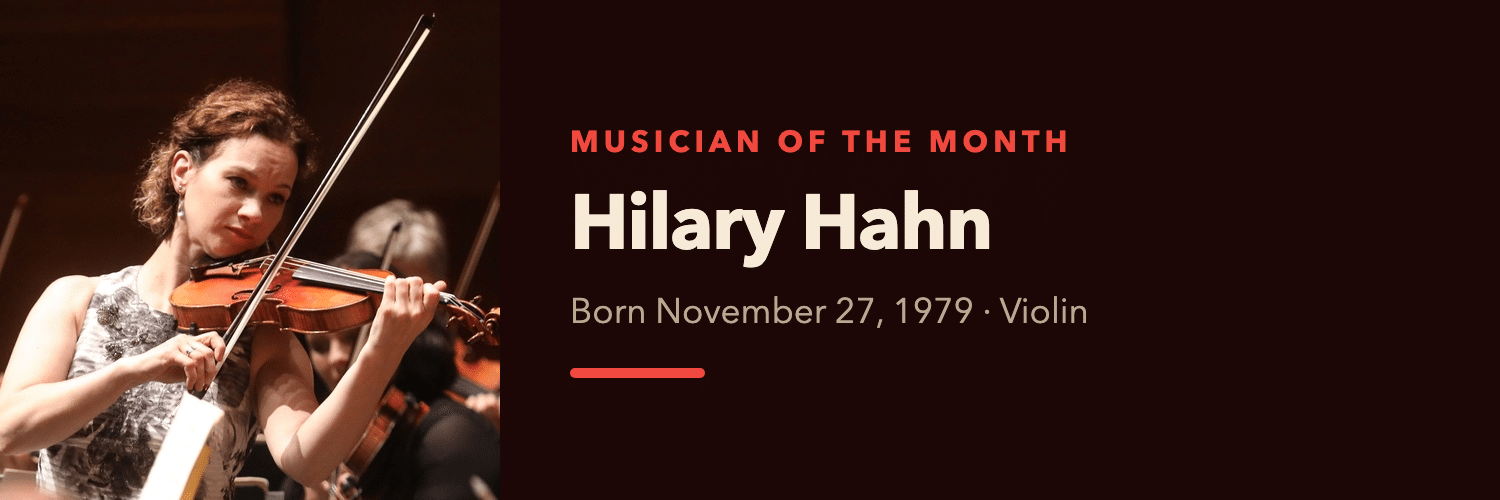
Photo: © Quincena Musical – Iñigo Ibáñez, CC BY 2.0 (cropped)
Hilary Hahn is our November Musician of the Month, and today is her birthday. She was born on November 27, 1979, in Lexington, Virginia, and grew up in the Baltimore area.
She has won three Grammys and has been recording for nearly thirty years. We picked her for this particular month for a different reason: she is the violinist who decided to show everybody the part nobody usually sees.
How #100DaysOfPractice Started
You may be the only person who regularly hears your child practice. Many musicians rarely get to watch another musician do it. Hahn once said she had never really been given access to see someone practice.
In 2017 she changed that. She had noticed visual artists posting their work every day for a hundred days, and she liked the idea of showing the process rather than the result. As she put it at the time:
“So it just occurred to me: What do I do every day anyway? I practice.”
She set up a camera during her ordinary practice, chose the one minute that best showed what she had accomplished that day, and posted it. Then she did it again the next day, for a hundred days, under the tag #100DaysOfPractice. Not a performance. One real minute of practice.
She said afterward that she had not expected anyone to care. Musicians did, and students especially. By the San Francisco Symphony’s count, more than a million posts now carry the tag, from players at every level.
The Account Belongs to the Violin Case
This is our favorite detail. The practice videos were not posted from Hilary Hahn’s own account. They were posted from @violincase, an account her biography describes as her violin case commenting on life as a traveling companion.
The case goes everywhere the violin goes. It sits in the corner of every rehearsal room and every airport, and it sees far more practice than performance. Inside it travel violins made in Paris in the 1860s by Jean-Baptiste Vuillaume, one of them a copy of the famous instrument that belonged to Paganini.
Ask your child what their instrument case would say if it could talk. For a pianist, try the piano bench.
She Says She Was Not a Prodigy
Hahn started the violin a month before her fourth birthday, in a Suzuki program at the Peabody Institute in Baltimore. She studied privately with Klara Berkovich from age five to ten, and at ten she was admitted to the Curtis Institute of Music in Philadelphia, where she studied with Jascha Brodsky for seven years.
That reads like a prodigy story, and the word follows her around. She has pushed back on it more than once, telling the New York Times that she never felt like a prodigy. Her own account of her childhood supports her. She went to an ordinary public elementary school until she was nine, and she had no manager and no record label until she was sixteen.
Her first public performance was in April 1986, when she was six, at a Friday evening recital in Baltimore. She played three short pieces, and one of them was the Gossec Gavotte. If your child is a violinist in our Suzuki program, they may be working on that exact piece right now. It sits in Suzuki Violin Book 1. When your child plays at one of our recitals, they are doing what she did.
She teaches now, too. She joined the violin faculty of The Juilliard School in 2025, is a visiting professor at the Royal Academy of Music in London, and has been named a visiting artist at the New England Conservatory for 2026–27.
Listening With Your Child
Start with the violin concerto Jennifer Higdon wrote for her. Higdon first met Hahn when Hahn was a student in her class at the Curtis Institute, and she named the first movement “1726,” after the school’s street address. Hahn premiered the concerto in February 2009, and in 2010 it won the Pulitzer Prize in Music for Higdon.
The whole concerto is long, so go straight to the third movement, “Fly Forward.” Higdon said the title was such a compelling image that she could not resist having the soloist do exactly that.
Listen for the race. Ask your child whether it sounds like the violin is running, and who is ahead, the violin or the orchestra.
Listen for the conversation. Ask whether the violin and the orchestra are agreeing or arguing, and whether that changes.
For something shorter, look up In 27 Pieces: The Hilary Hahn Encores. She asked twenty-six composers for short encore pieces, then ran an open contest for the twenty-seventh. More than four hundred people entered, and the winner was Jeff Myers, with The Angry Birds of Kauai, about the squawking birds there. It is a real piece on a Grammy-winning album, with a title your child may recognize.
Try This at Home
You can borrow Hahn’s idea this week, and it works with even a few minutes of practice a day.
- Set up a phone during your child’s normal practice.
- Afterward, watch it together and choose the one minute that best shows what they accomplished today.
- Ask them what they are proud of in that minute.
- Play it for their teacher at the next lesson.
Keep it off social media. The point is the choosing. Picking your best minute means paying attention to what got better, which is a big part of what a good practice session is for.
Book a free trial lesson at The California Conservatory of Music today!