November 23, 2026
Manuel de Falla: November Composer of the Month

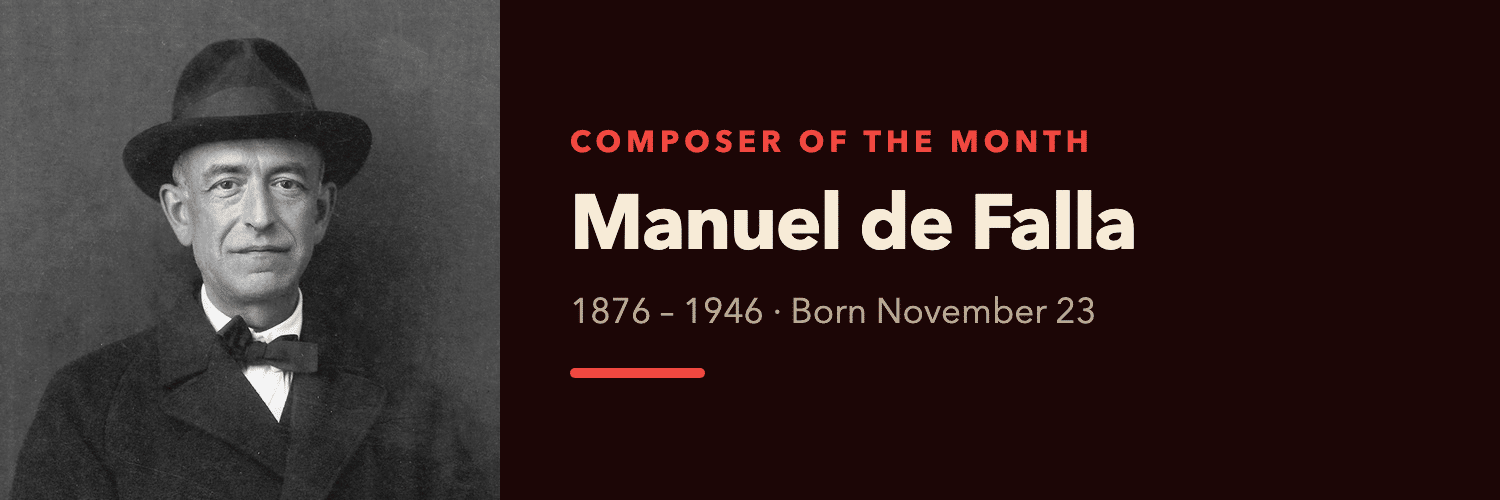
Manuel de Falla is our November Composer of the Month, and he was born 150 years ago today: November 23, 1876, in Cádiz, on the Atlantic coast of southern Spain. Spain has made 2026 an official anniversary year, and Cádiz is marking the day itself with a concert.
Falla was a pianist, taught first by his mother, and his music reaches every kind of young musician: a fiery dance that a famous pianist made his encore, a ballet with sets by Pablo Picasso, and a single piece for guitar that he wrote by asking a guitarist for help.
The Piece Your Family Might Already Know
In 1915, Falla wrote El amor brujo, a Spanish ghost story told in dance. A young woman named Candelas is followed everywhere by a jealous ghost, and at midnight she tries to drive it away with a ritual around a fire.
That scene is the Danza ritual del fuego, the Ritual Fire Dance, and it is the most recognizable music Falla wrote. The pianist Arthur Rubinstein made it one of his signature encores, playing an arrangement Falla made himself. Search for it by name, adding “piano” for Falla’s own arrangement or “orchestra” for the full sound.
If your family enjoys it, try his ballet The Three-Cornered Hat next. It is a comedy about a boastful town official who is outwitted at every turn, and when it opened in London in 1919, the scenery and costumes were designed by Pablo Picasso.
Listening With Your Child
The Ritual Fire Dance runs about four minutes, short enough to hear twice in one sitting.
Listen for the trill at the very start. The music shivers before anything else happens. Ask your child what it sounds like. Fire, cold, something about to happen: all of them are good answers.
Listen for the short tune that keeps coming back. Ask your child to count how many times it returns, and whether it feels the same each time or whether something underneath it is changing.
Listen to the ending. The same chord is struck again and again. Ask your child to count the strikes. Then ask what Candelas is trying to do, and whether the ending sounds as if it worked.
One Piece for Guitar, Written With Help
Two years after Claude Debussy died in 1918, a Paris music journal asked well-known composers for tributes. Stravinsky, Ravel, Bartók, Satie and Paul Dukas all sent music. Falla had been asked for a written article. He sent music instead, and he was the only one of them to write for guitar.
The piece is Homenaje, pour le tombeau de Claude Debussy, written in Granada in the summer of 1920.
Here is the part worth telling a guitar student. Falla was not a guitarist. The guitarist Miguel Llobet had been asking him for a guitar piece for years, and in the spring of 1920 the two of them met in Madrid so Llobet could advise him on writing for the instrument. That is the kind of help only a guitarist can give a composer: knowing what the left hand can reach, and which chords fall naturally under the fingers. Llobet gave the first performance in February 1921.
So one of the guitar’s landmark pieces was written by someone who did not play it, because he asked somebody who did. Falla was one of the most admired composers alive, writing in memory of one of the most famous composers in Europe, and he began by asking a guitarist for help.
Listen for Debussy near the end. Homenaje takes about three and a half minutes. Just before it finishes, a few notes from Debussy’s piano piece La soirée dans Grenade drift in. Ask your child whether they can hear the moment something new arrives. If you have a pianist at home, listen to the Debussy together afterward and see if they can hear the same tune. That is Falla saying goodbye to his friend.
Last Month’s Composer Opened the Door
October’s Composer of the Month was Paul Dukas, and the two stories join up. Years later, Falla wrote a set of musical tributes called Homenajes and gave Dukas one of its movements. The guitar piece for Debussy is in the same set, arranged by Falla for orchestra.
The reason goes back to 1907, when Falla arrived in Paris as an unknown Spanish composer with the score of his opera La vida breve under his arm. Dukas took up his cause and introduced him to the people who mattered in Paris, Debussy among them. Ravel soon became a friend as well.
Try This at Home
The Homenaje story has an activity hiding in it, and it takes ten minutes.
Have your child teach you one thing about their instrument. Not a performance. A lesson.
- Ask them to show you how to hold it properly, or, if they sing, how to stand.
- Ask them to show you two notes that sound good together, or one after the other, and then two that do not.
- Then ask them to help you make a sound on it yourself. If your child sings, ask them to teach you how to breathe for a long note.
This works whether they have been playing for ten years or five months, and whether or not you have ever touched an instrument. That is the point. Falla was in much the same position in 1920, and the piece that came out of it is still being played more than a century later.
For more on talking with your child about their playing, see our guide for parents.
Book a free trial lesson at The California Conservatory of Music today!