August 21, 2026
Lili Boulanger: August Composer of the Month

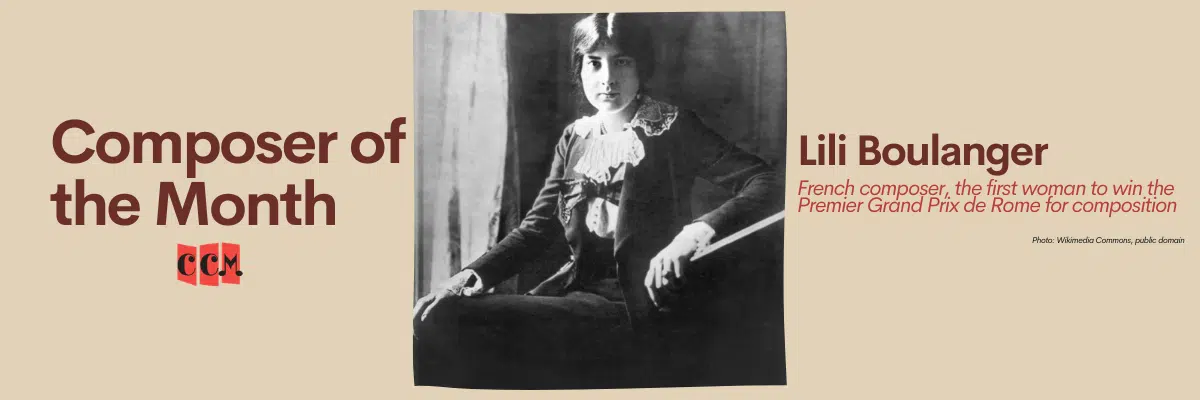
In 1913 a nineteen-year-old walked into the most prestigious competition in French music, went up against men six years older than she was, and won it outright. Lili Boulanger was the first woman ever to take the first prize for composition, and our Composer of the Month for August. She wrote a small body of remarkable music in a short life, and people are still discovering it a century later.
Early Life and Inspirations
She was born into a musical household in Paris. Her father Ernest was a composer who had won the Prix de Rome himself, decades earlier. Her mother Raïssa was a Russian singer. Her older sister Nadia, six years ahead of her, would go on to become one of the most influential composition teachers of the twentieth century, the woman who taught Aaron Copland, Philip Glass, Astor Piazzolla and Quincy Jones.
There is a story from the family that their father, already elderly, asked six-year-old Nadia to promise she would look after her baby sister. Nadia kept that promise for the rest of Lili’s life, and for sixty-one years after it.
Lili was two when she caught bronchial pneumonia. She survived, but her health remained fragile for the rest of her life. She could not attend school reliably. What she could do was sit in on Nadia’s lessons at the Paris Conservatoire, absorbing harmony and counterpoint before she was old enough to enroll.
The Prize No Woman Had Won
The Prix de Rome was the most prestigious award in French music. Berlioz won it. Debussy won it. Women had only been permitted to enter the composition competition since 1903, and none had taken the first prize.
In 1913, at nineteen, Lili entered with a cantata called Faust et Hélène. She was the youngest competitor by six years. She won the Premier Grand Prix with thirty-one of the thirty-six votes.
The press coverage was enormous, and much of it focused on her age and her gender rather than her music. What the music itself showed was a composer who already knew exactly what she wanted: long unfolding lines, harmony that moves in unexpected directions, and an unusual gift for setting text so that the words keep their shape.
Five Extraordinary Years
Her health shaped how she worked without ever stopping her. She wrote from a chair, or from bed on the harder days, and in the five years after the Prix de Rome she produced many of the works for which she is now best known.
Two pieces from that stretch show her range better than any description could. Psalm 130, “Du fond de l’abîme,” is enormous and slow and shadowed, written for choir and orchestra and dedicated to her father’s memory. D’un matin de printemps is five minutes of spring light, quick and bright and full of air. She was working on both at the same time, which tells you something about the size of the imagination involved.
Her last piece was a Pie Jesu, dictated to Nadia when writing had become too difficult. Lili died in March 1918, at twenty-four.
Nadia lived another sixty-one years, and spent a good deal of that time making sure her sister’s music was published, performed and taught. It is largely thanks to her that we can still hear it.
What Students Can Learn from Lili Boulanger
There are two things in her story worth passing on to a young musician.
The first is that she was in the room. Long before she was old enough to be a student herself, she was sitting in on her sister’s lessons, listening to material she was not supposed to understand yet. Being around music you cannot play yet is not wasted time. It is how the ear gets built.
The second is that she wrote what she wanted to write. She was nineteen and the entire French musical establishment was watching, and she did not produce something safe. Students often think there is a correct thing to make. There usually isn’t.
Start Listening
Begin with D’un matin de printemps. It runs about five minutes, it exists in versions for orchestra, for piano trio, and for violin or flute with piano, and it is within reach of many advanced students. It sounds like a morning.
Then try Psalm 130 if you want to hear the full scale of what she could do, and the Pie Jesu if you want to hear the last thing she wrote.
Listen for the restless movement in D’un matin de printemps, the way the colors keep shifting under a line that never quite settles. In Psaume 130, listen for how gradually it expands, and how much scale she builds from a quiet opening.
Many of her scores are available through IMSLP, though copyright status varies by country and edition. There is not very much of it. That is rather the point.
Sign up for a FREE introductory lesson at The California Conservatory of Music today!